Friday, October 23, 2015

There is a better solution to obesity than so-called fat taxes

Dear Students,

Are you or your family member facing problem with OBESITY??? Read this article for solution.......


A wake-up call is needed to address obesity, but it appears it is time to look for alternative solutions to a fat tax. Instead of punishing bad behavior as our health formula, we can work to incorporate how good thinking promotes health.
I'm talking about more than the general recognition that positive thinking is better than negative thinking for our well being. From my own experience, I advocate a diviner kind of thinking.
I find Jesus' advice to "take no thought for your life, what ye shall eat or what ye shall drink," and his question, "Is not the life more than meat?" very helpful in finding balance in food consumption and weight gain.
It's pretty radical advice when you consider that a significant portion of a person's life revolves around food in one way or another — from the first thought of what to eat for breakfast, to what to eat during work breaks, to planning for dinner, to scheduling grocery shopping, to deciding what to indulge in along with entertainment. Food reminders are everywhere!
It's interesting to note that these biblical admonitions are sometimes matched by secular advice not to make food the focus in mind-body workings. But doing this isn't as easy as saying it.
What's helped me most in this direction is learning that what we truly crave is divine substance — the sweet awareness of our deep relationship to the divine. That perspective, renewed regularly, isn't as easily thrown off balance during day-to-day stressful decision-making situations that might otherwise encourage poor food choices. Our true sustenance and satisfaction is from God, and holding to this idea is a potent deterrent to thoughtless or unnecessary eating.
A deeper understanding and respect of our spiritual individuality can free us from an unbalanced emphasis on food, and give us a basis for self-control. And an added benefit is that we can naturally avoid food taxes even where they are being applied!

DON INGWERSON, a Christian Science practitioner, lives in Laguna Beach.
Courtesy:  Daily Pilot

Tuesday, October 20, 2015

Turning points by A.P.J Abdul Kalam


Turning points by A.P.J Abdul Kalam is definitely a inspiring sequel to wings of fire, where the journey of wings of ends with the life journey another begins with turning points . Mr kalam talks about his journey after 1992 and the challenges he has faced as the President of India and certain points of controversy for the first time. It is a must read for the lovers of this author who now has written close to 21 books in his career.
It offers extraordinary insight into the personality of the author and also the dream of making India a country with great accomplishment, skills, through perseverance, heritage and confidence beyond a developed nation by 2020 .He says this journey is a continuing saga of a individual and collective that will make us achieve this dream.
Mr Kalam spoke about the Seven turning points in life where he became the captain of the problems and defeated them to succeed.
In the opening chapter When Can I sing a Song about India ? Mr kalam speaks beautifully about the journey as the president, starting off with his last day in office like a flashback to the kind of people he met in this journey from a farmer, postman to officers and administrators. In the words of the author “ Here are a few events that lightened my horizon ,bought a smile to my lips, taught me lessons and engaged me with the love of my countrymen,
The belief of his is that the ignited mind of the youth is the most powerful resource of the earth, above the earth and under the earth. In the preluding chapters he talks about his journey of how much he loves teaching and when he was in Chennai at the Anna University and the turn of his life when he was nominated for the post of the president of India and his journey and turns from there of how he thought of blending his dream about India by 2020 and the political dais he was standing on as a platform in his mind’s eye.
In his own words beautifully phrased his dream “The innocence filled with wisdom of the simple people of my land always gave me the confidence that my country will lead the world to peace and prosperity.”
The 7 turning points have been explained first one as a scientific assistant at the Aeronautical Development Establishment to Rocket Scientist at Now ISRO. The Second turning point with entry into Indian Missile Programme, third one came as he became the scientific advisor to the defence minister; the fourth point was nuclear tests well the rest I guess it’s best to find out as your journey in the books begins.
The books speaks about the journey as a visionary of India and with how responsibility comes with great powers. Well it’s a worth a read to find out more about our former President of India Mr Abdul Kalam his work and vision.

Courtesy :  Chhatrarth

Thursday, October 15, 2015

Positive Thinkers Are Protected From Heart Disease by Adhering To Healthy Habits

Humans are directly affected by the quality of their thoughts. More and more scientific studies are, thus, focusing on the effects of positive thinking. Researchers from Penn State University have recently studied positivity in relation to heart disease: does it really impact positively on the heart’s health? Find more in the paper published in Psychosomatic Medicine.
heart
Previous research has shown that the recovery and survival rates of patients having gone through heart bypass surgery seem to be better in those who adhere to positive thinking. Conversely, breeding negative thoughts affects the health adversely. The new research deals with a similar topic: how do patients with coronary heart disease (CHD) benefit from positive emotions?
A team led by researcher Nancy Sin followed over a thousand patients with CHD to analyse the benefits of positive feelings. The psychological health of the patients was evaluated twice (at the beginning of the study and after 5 years). The participants had to rate the extent of 10 positive emotions, such as “interested”, “proud”, “enthusiastic” and “inspired”. Other variables were recorded, like physical activity, medication, alcohol, cigarette, depressive symptoms, and their heart conditions.
The results show that participants with higher positive psychological states are more likely to indulge in physical activities, and they sleep better.
They also adhere to their heart medications, and are less likely to smoke.
No link was identified between positive emotions and alcohol consumption.
The researchers explain that positive emotions thus appear to be linked with various long-term healthy habits that are associated with lower risk of future heart problems and death.
Furthermore, increases in positive emotions during the 5 years following the start of the study are correlated with improvements in physical activity, sleep quality and medication adherence.
According to the researchers, positive people might be more motivated to stick to healthy behaviours and to persevere over time. They could also be better at managing stress and obstacles.
Nancy Sin hopes their findings will lead to more research on interventions to improve health habits.

Thanks to the Source: http://news.islandcrisis.net/2015/10/positive-thinkers-are-protected-from-heart-disease-by-adhering-to-healthy-habits/

Tuesday, October 13, 2015

The Simpler Things: Tips for the midterm mental breakdown


We all have a breaking point in college. Sometimes it involves an obscene amount of alcohol, a heaping plate full of bad decisions and a nice side of lifelong regret. And sometimes, it involves some kind of psychotic meltdown. One day, everything seems normal, then your roommate comes home to find you hysterically laughing at something most people would find only slightly amusing, like a dog wearing a funny hat — but you’ve been in tears laughing and rolling around on the floor for 30 minutes now. You know what I’m talking about, and if you don’t it's because you are new to college and will find out extremely quickly how true this is. If you are lucky, you haven’t had a complete mental breakdown yet, where you question everything you’ve ever done, what you’re doing with your life and contemplate pursuing your true calling as a beach hobo who sells balloon animals but decide against it because you haven’t fully mastered the art of balloon animal making yet, but one day. Yes, one day…
I do have three helpful tips to help you delay this inevitable break down, though. If I am too late getting to you, then maybe I can help you avoid the second round for as long as possible (Yes, there are multiple rounds. Welcome to the real world; it sucks).
1. Guilty Pleasure: If you can feel yourself on the verge of a breakdown (I’m talking something small, like the line at Starbucks being too long, someone looking at you funny or even pulling a push door that is going to send you over the edge), I encourage you to indulge in one of your favorite guilty pleasures. Whether it’s reading People magazine, eating a weird combination of junk food or people watching, do it, and do it as soon as possible. If you can avoid a meltdown by simply consuming an unknown amount of calories (do not EVER read the label if you are eating purely for comfort) or watching corny movies, then put everything else on hold and do so.
2.(Un)positive thinking: Sometimes we don’t have the luxury of ignoring the world for the day to stay sane. That means it’s time for some good old fashioned (un)positive thinking. What is (un)positive thinking, you ask? Let me enlighten you. It’s when you try your best to look at the bright side of things, end up looking at the negative side of things and yet still feel better. For example: Sure my roommate ate the last Pop-Tart, my boyfriend dumped me and my cat died, but my favorite cheap wine is on sale, and now I have a good excuse to drink. Or maybe your problems start to seem not as bad, because you see someone struggle-bussing really hard in Hodges. It’s not bad to laugh at other people’s pain if you do it in your head, right?
3.Power through: As tempting as the first two options are, to be blunt, life happens; and most of the time we have no other option but to power through. This is the most mature option of all three and is only recommended for those with zero self-hatred and a high level of self-control. That’s not to say it is impossible though. As Vols, we put the Power T in Power Through.
All three of these methods have high success rates, as long as you catch the meltdown before it begins. So just remember, as tempting as it is to drop out and chase fame through your mad vlogging skills (give up now), find something that keeps you sane and keep your head up. Even though things are hard now, and college seems like a form of torture at times, enjoy every second of it. Eventually the stress from finals and essay deadlines comes to an end when you graduate and something far worse ensues: real life.

Emily Moore is a sophomore in journalism and electronic media. She can be reached at emoore52@vols.utk.edu.

Thursday, October 8, 2015

Change your attitude, change the world

Dear Students,
Here is a formula for you to Positive Life by Chris A. Quilpa....

Do you want to make a positive difference in the world? Have a positive attitude.
An attitude is the state of mind with which you approach a situation. Here are a couple of examples: Maybe you tell yourself, “I’m going to get things done today.” (That’s a positive attitude.) Or does this sound more like you? “Today will be lousy, like yesterday. (That’s a negative attitude.)
The day might be out of your control, but the only you can control your attitude.
Attitude is so important because it affects how you look, what you say and what you do; it affects how you feel both physically and mentally; and it affects how successful you are in achieving your goals.
Do you take a positive attitude toward yourself? Do you try to learn to recognize that no one has all the answers? Do you try to do a better job and suggest better ways of doing your work? Do you demonstrate enthusiasm in whatever you say and do?
Are you willing to grow to prepare yourself for a better job? Are you willing to welcome change — to experiment, try new ideas and stay loose? Do you cultivate a sense of humor — not taking yourself too seriously — getting some fun out of your work?
Likewise, do you have a positive attitude toward others? Are you sincerely interested in them and their purposes and problems? Do you try to understand others’ point of view — how they feel and why they feel, think, look and act as they do?
Are you a good listener who tries to learn something from others? Are you able to work with them to achieve common goals, and not to criticize them?
Developing positive attitudes takes time and effort. Here are a few simple positive attitudes that will make your life fulfilling and your family happier:
  • Keep each other informed. Good communication is the key to a good relationship.
  • Try to be punctual. It’s the Golden Rule of time for everybody.
  • Try to be cheerful, even if you don’t feel like it. Nobody likes a sourpuss.
  • Use polite words like “Please,” “Thank you,” “May I?” and “Do you mind?”
  • Try to be helpful. You’ll build friends fast.
  • And try to be patient. Some things just necessarily take time to do right. Patience is a virtue.
While negative attitudes make life difficult for everyone, positive attitudes help everyone get the most out of life. Negative attitudes get you nowhere, whereas positive attitudes make every day better.
With positive attitudes, your life is more meaningful, problems easier to handle, goals more attainable, mistakes less disastrous, and the future more exciting.
Talent is important, and knowledge is essential. But, I believe the most important key element to success is your state of mind. Whatever your situation or disposition in life is, success is your attitude!
A positive attitude at work can make your daily routine more rewarding and enjoyable. You can say, “I’ll do my job as well as I can so that others can depend on me.”
Why not begin practicing positive thinking to create a positive attitude right now?
Chris A. Quilpa, a retired U.S. Navy veteran, lives in Suffolk. Email him at chris.a.quilpa@gmail.com.

Friday, September 25, 2015

The Ultimate Happiness Variable

Dear Students,

Here is an outstanding article on "Ultimate Happiness" for you, written by Michael.....
Don't just read, Digest it....


HAPPINESS 

The other day, I woke up feeling incredibly sad. In times past, when it still seemed to me like having a "negative emotion" was problematic, that feeling would have launched me into a search for what was wrong in my life and an even more enthusiastic search into my collection of self-help and psychology books for a solution that would eliminate the feeling of sadness and then eventually help me to upgrade my life to a point where I wouldn't ever have to feel that sad feeling again.
However, the world doesn't look that way to me anymore, and "sad" now just seems like one of the many things I might feel during a typical day, no more or less significant than "upbeat", "fearful", "curious" or "amused." So instead of trying to "fix" it, it occurred to me to look deeper into what feeling sad in that moment might be telling me about my overall state of mind. When I did, two things quickly became apparent to me:
1. I was feeling the content of my thinking
One thing feeling sad was clearly a reliable indicator of was that I was thinking "sad thoughts." Since we live in the moment by moment feeling of our thinking, a sad feeling is as closely related to "sad" thinking as "tails" is related to "heads" on a coin.
If I was looking to change my feeling state, this thought/feeling connection would suggest that the obvious thing to change was the content of my thoughts. As there are many wonderful people and thing in my life and in the world, it would seem easy enough to simply will my thoughts towards the positive and then I'd get to feel good.
This is the logic behind the positive thinking movement -- that since thought creates feeling, learning to control or master our thoughts would make us masters of our feelings. Whether or not controlling our feelings is a good thing (and whether or not anyone really successfully controls the content of their thinking over time) are the often overlooked questions that to me hint at the problems that come with our attempts to control our experience (and sometimes even the world) by controlling our thoughts.
2. My thinking was looking at least somewhat real to me
One of the interesting things I've noticed about my thinking is that there are times where it doesn't seem like thinking to me at all. In those moments, people just "are" untrustworthy, life "is" hard, and I "am" at the mercy of my thoughts, feelings and experiences.
Yet there are other times where all the same crazy thinking is going through my head and it doesn't seem to get to me at all. I craft a revenge fantasy in my head and it makes me laugh out loud instead of striking me as a sensible or viable plan of action. In the language of the Three Principles, this variability in my experience of my thinking in the face of nearly identical content is explained by the principle of Consciousness.
While at a universal level, consciousness is simply the power that allows us to be aware of and experience life, our individual consciousness expands and contracts throughout the day like an aperture. When our aperture is contracted (i.e. a "lower" level of consciousness), life looks frighteningly real to us and the world is filled with problems that we'd better get to before they get to us. When our aperture expands, we begin to once again see the variable nature of our own thinking and its utter impotence in making us do anything our deeper wisdom guides us not to do.
This points to why I recently described the impact of a deeper understanding of the Principles like this:
"After you learn the Principles, you still might write a 'Dear F@#%face' letter, but you're increasingly unlikely to send it."
As we see more about not only the infinite potential variety of thought content but also the simple, binary variable of consciousness expanding or contracting through the day, it makes less and less sense to try to "do" anything about our feelings and more and more sense to use them as a barometer of our current level of consciousness.
The more real the world is looking to us, the less equipped we are to deal with it; the more we recognize the variable and arbitrary nature of our own thinking, the more likely we are to hear and follow the gentle feeling of our wisdom as it guides us forward.
This is why to me the "ultimate" happiness variable is not in changing the content of our thoughts but rather in increasing the level of our understanding. To tweak an old proverb, it's the difference between changing our feeling in the moment and changing our relationship to our feelings for a lifetime.

With all my love,
2014-08-17-20130402michaelsig.gif

Wednesday, September 16, 2015

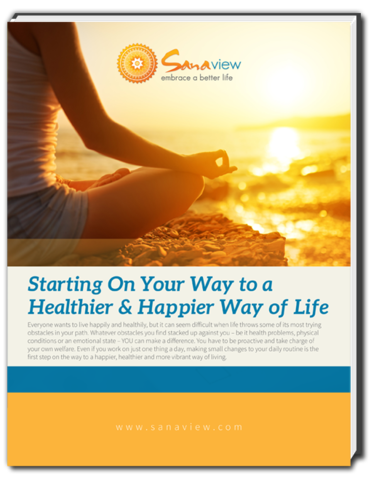
Guide To Healthier & Happier Way of Life

Dear Students, 
Here is a Guide for you to Healthier & Happier Way of Life...

Start embracing a better way of life and download the healthy living guide from SanaView today.

No matter what our age or obstacles that life throws ahead of us, we are the only ones who can take charge and make a difference in our lives. Discover just how a little positive thinking and a new way of eating can help lead you to a happier, healthier and more vibrant way of life with help from SanaView.

When it comes to healthy living, even making the smallest changes to your diet or your attitude can make a big difference in your overall wellbeing. Rather than sulking in our failures, focus on the positives and take a proactive approach to changing your life.

One of the best things you can do for your body is to make the switch from processed to whole fresh, plant-based foods. Following a diet that is high in fresh, raw fruits and vegetables, nuts and seeds will help keep you looking and feeling younger, taking your body to its peak and managing stress and fighting off disease in ways you never thought possible.

Clean eating aside, being positive can make a world of difference for your welfare and health. While at times it may not seem easy, collecting the courage to look at any obstacle life throws at you in a productive manner will help you battle stress and depression. Turn your negative self-talk around with some positive spin, and you'll be well on your way towards a healthier and happier lifestyle.

One of the biggest obstacles we all face on a daily basis is stress management. However, a positive approach coupled alongside a plant-based diet may just be the secret to minimizing all the stresses in your life. SanaView suggests taking some time to cut back on your calendar, and even unplug from the world around us once in a while by enjoying the little things that make our lives so special.

When you're less stressed, you can take the time to plan better meals and eat healthily. When you unplug from your job or your electronics, you can build those valuable relationships that add pleasure to your everyday life. Being positive and eating right is the key to living healthier and happier, and all it takes to get there is some determination on your part.

Start on your own path towards a healthier way of life by signing up for a premium membership from SanaView. Featuring plant-based recipes and other healthy living advice, SanaView is your guide towards embracing a better way of living. Attend the upcoming Rejuvenation Retreat at Nemacolin Woodlands Resort, held on Saturday, September 26th and discover for yourself just how effective a positive state of mind and a clean diet can be for your health and happiness. For more information on all that SanaView has to offer, visit http://sanaview.com today. 

Janet McKee
SanaView